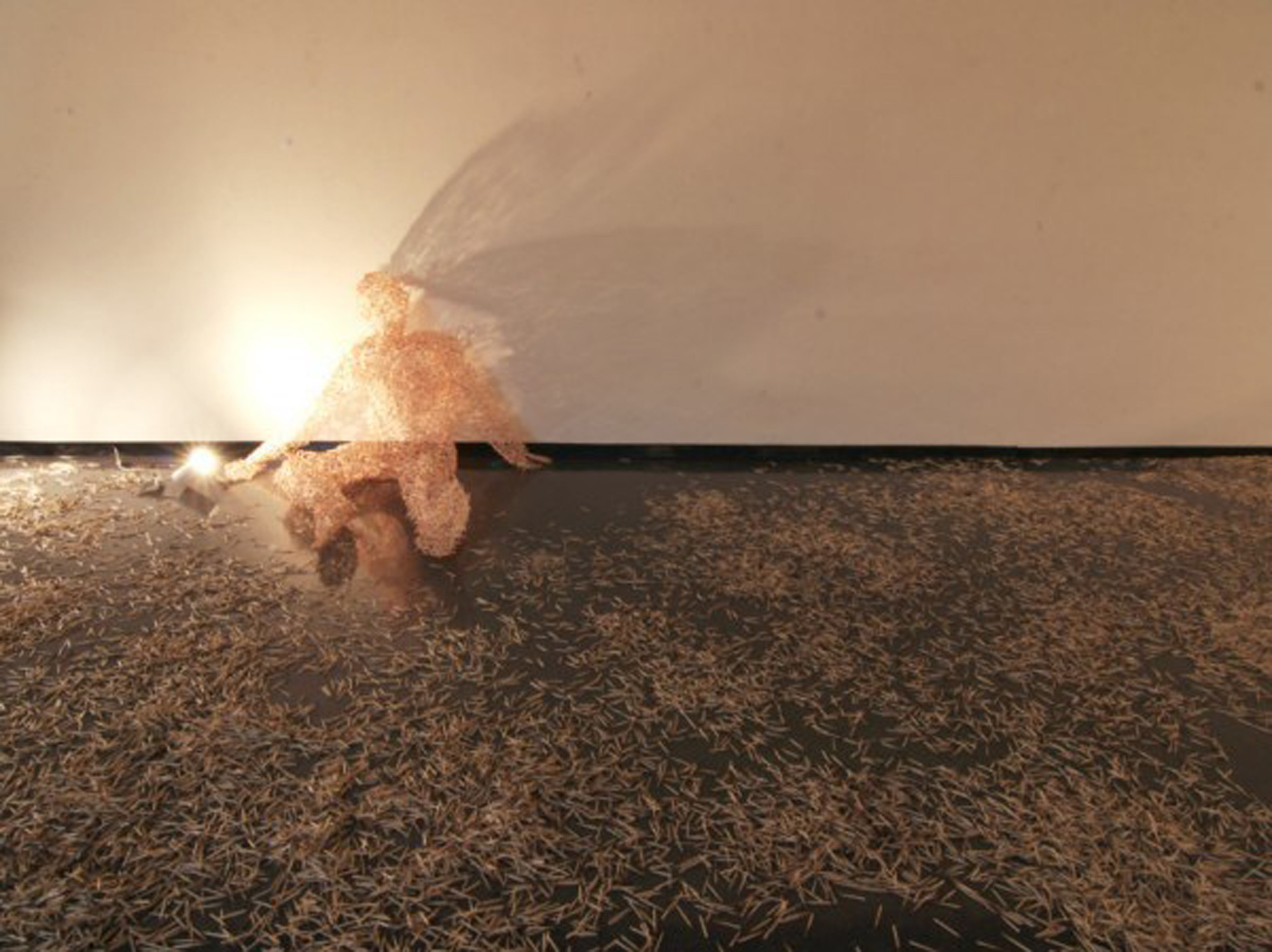
matchstick drawing

unused matchsticks, used matchsticks

Variable size

2009
未使用のマッチと使用済のマッチ

サイズ可変

2009年
image01

マッチを用いたこの作品は、未使用のマッチで座り込んだ人型を象り、その周囲には使用済みのマッチを散乱させている。素材は「未使用のマッチ、使用済みのマッチ」のみ、サイズは可変とされる。

造形的に見るならば、本作はマッチ棒という均質な線状のユニットのみによって構成されている点に特徴がある。一本のマッチは、それ自体としては最小の記号性しか持たない直線の断片に過ぎない。それが束ねられ、並べられ、集積されることで初めて「人型」という像が浮かび上がる。単位の反復によって像を立ち上げるこの手続きは、点や線の集積として像や文字が成立する書字・運筆の原理と重なるものであり、本作が「絵画」でも「彫刻」でもなく「ドローイング」を名乗っている所以でもあるだろう。

さらに見落とせないのは、未使用/使用済という二項対立が、素材そのものの物理的状態の違いとしてそのまま視覚化されている点である。未使用のマッチは、発火という出来事をまだ経ていない、いわば可能性のうちに留まる物質である。対して使用済みのマッチは、発火という一回限り・不可逆な出来事を経たのちの残滓であり、すでに終えられた出来事の痕跡そのものである。人型を形づくるのが前者、その周りに散乱するのが後者であるという配置は、一つの静止した身体と、それを取り巻く無数の「済んでしまった」小さな出来事――発話、行為、時間――との関係を暗示している。座り込むという動きのないポーズは、おびただしい残滓に取り囲まれながら、なお留まり続ける身体として読むことができる。

こうした、燃焼という不可逆な一回性の行為を発話や記述のアナロジーとして扱う視点は、清水玲がその後一貫して展開していくことになる、文字や言葉をめぐる一連の試みの出発点として位置づけることができる。同じ2009年に着手された《CNJPUS TEXT》をはじめ、2013年以降継続する《projects of altering letters》シリーズ、線的な痕跡そのものを主題化した《storokes》(2017–2018)、そして2020年の《散體千字文(scatterd characters)》に至るまで、清水は文字や言葉を、意味を伝達するための記号としてではなく、書く・貼る・剥がす・並べる・燃やすといった具体的な身体的行為の産物として、また空間のなかで集積・散乱・配置されうる「もの」として扱い続けてきた。とりわけ、使用済みのマッチが本作の周囲に「散乱」する様態は、後年の《散體千字文》における文字の散らばりというモチーフと明確に呼応する。その意味で《マッチ・ドローイング》は、単発の実験作にとどまらず、単位の集積がいかにして像やテクストを生成しうるか、またその生成の過程自体がいかに時間と身体の痕跡を刻みうるかという、清水の制作を貫く問いの最初期の実践として捉えることができるだろう。

Made using matches, this work forms the outline of a seated human figure from unused matches, with used matches scattered around it. The materials are listed simply as "unused matches, used matches," and the dimensions are variable.

Formally, the work is distinguished by being built entirely from a single, uniform linear unit: the matchstick. On its own, one matchstick is little more than a straight fragment carrying almost no signifying power. Only when these units are bundled, arranged, and accumulated does the image of a "human figure" emerge. This procedure — raising an image through the repetition of a single unit — overlaps with the underlying principle of writing and brushwork, in which images and characters are likewise formed through the accumulation of dots and lines. This is presumably also why the piece identifies itself not as a "painting" or a "sculpture," but specifically as a "drawing."

Equally significant is the way the unused/used binary is made visible directly through the differing physical states of the material itself. An unused match is matter that has not yet undergone the event of ignition — it remains, so to speak, in a state of pure potential. A used match, by contrast, is the residue left behind after undergoing the singular, irreversible event of ignition: it is itself the trace of an event already concluded. That the figure is formed from the former while the latter is scattered around it suggests a relationship between one motionless body and the countless small, "already-finished" events — utterances, actions, time itself — that surround it. The seated, unmoving pose can be read as a body that remains in place even while encircled by an abundance of such residue.

This way of treating combustion — a singular, irreversible act — as an analogy for utterance or inscription can be positioned as the starting point of the sustained inquiry into characters and language that Ryo Shimizu would go on to develop. From CNJPUS TEXT, begun that same year, 2009, through the ongoing projects of altering letters series (2013–), storokes (2017–2018), which foregrounds the linear trace itself, to 散體千字文 (scatterd characters) (2020), Shimizu has consistently treated characters and language not as signs for conveying meaning, but as the products of concrete physical acts — writing, pasting, peeling, arranging, burning — and as "things" that can be accumulated, scattered, and arranged in space. In particular, the way used matches are "scattered" around this work resonates clearly with the motif of scattered characters in the later scatterd characters. In this sense, Matchstick Drawing can be understood not merely as an isolated experiment, but as the earliest practice addressing a question that runs through Shimizu's entire body of work: how the accumulation of a single unit can generate an image or a text, and how that very process of generation can inscribe the trace of time and the body.

image01
© ryoshimizu.jp